
Wasp and Hornet Removal
Nests under eaves, decks and porch roofs, in sheds, in the ground and inside walls, around houses, rentals and small businesses. Each kind of wasp builds and defends its nest differently, and that decides how it comes down.
Nests Over Doors and Under Roofs
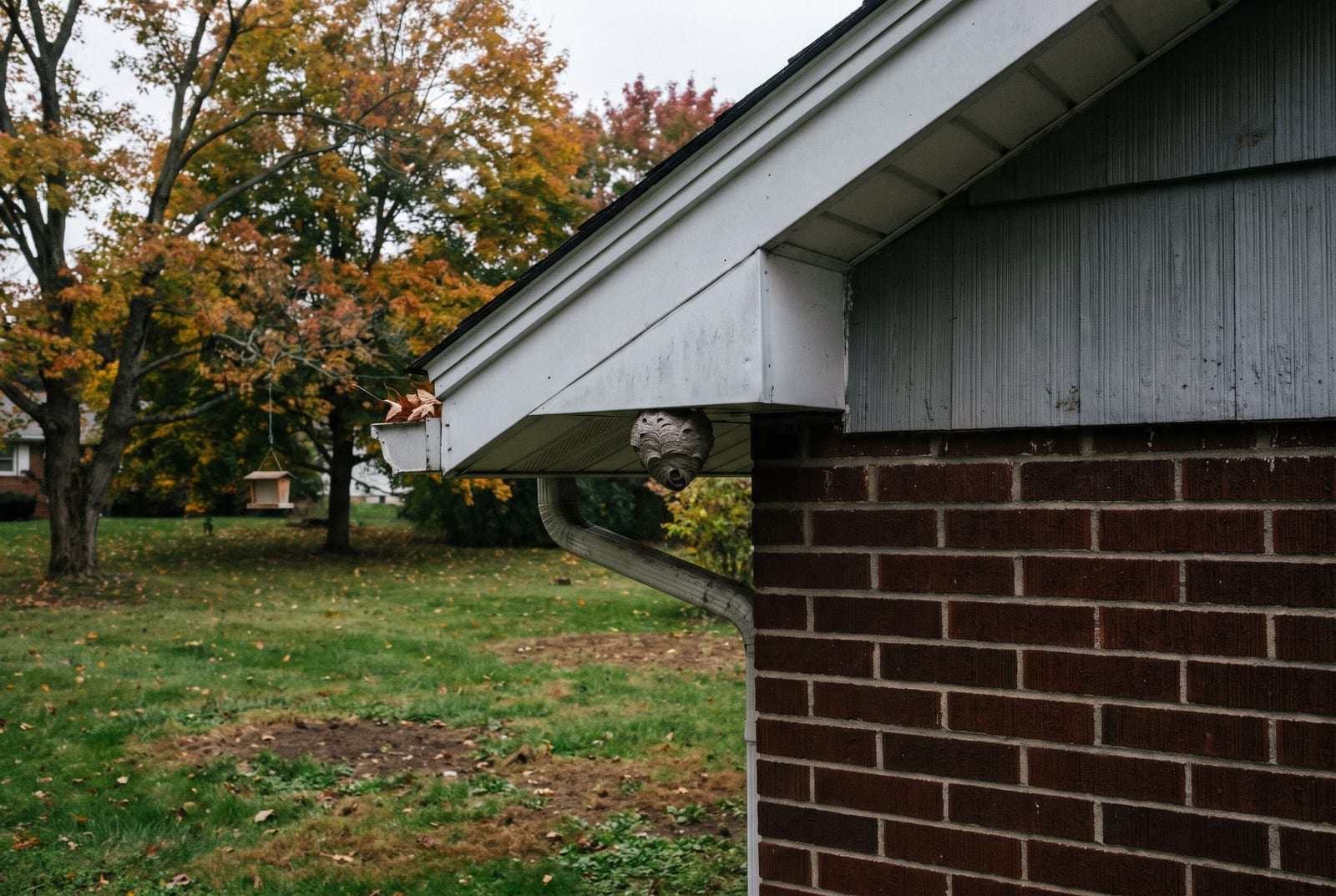
A nest often goes unnoticed until it fills a corner and the wasps start meeting people at the door. Wasps choose sheltered spots out of the rain: the corner over a door frame, the underside of a porch roof, a soffit, the rafters of a shed or a gap in the siding that leads into the wall. A paper nest tucked under the porch roof grows a little every week, and so does the number of wasps that defend it.
Nests turn up on businesses as often as on homes. A nest over a shop entrance or a building’s back door puts staff, tenants and customers in the path of the colony every time the door opens.

Paper Wasps, Yellowjackets and Hornets
Paper wasps are slender and long-legged, with legs that dangle in flight. They build open combs with the cells showing and sting when the nest is touched or bumped, but their nests stay small.
Yellowjackets are short, stout and banded black and yellow. They hide their nests in the ground, often in an old rodent burrow, or inside wall voids and attics, and a late-summer colony runs into the thousands. They are the wasps at picnics and garbage cans, and the ones that pour out when a mower passes over the entrance.
Bald-faced hornets, black with white markings, are in fact a kind of yellowjacket, and they defend their gray, football-shaped nests hard. European hornets are larger, brown and yellow, nest in hollow trees and wall voids, and are the ones that fly at night and bump against lit windows. Mud daubers build tubes of dried mud and rarely sting at all.

| Insect | Nest appearance | Typical nest locations | Risk level |
|---|---|---|---|
| Paper wasps | Open gray comb shaped like an upside-down umbrella, cells in view | Eaves, porch ceilings, railings, light fixtures, shed rafters | Moderate: they sting when the nest is touched |
| Yellowjackets | Enclosed paper nest with one entrance, usually out of sight | Holes in the ground, wall voids, attics, under decks | High: large colonies that defend the entrance in numbers |
| Bald-faced hornets | Gray, football-shaped paper nest with an opening near the bottom | Tree branches, shrubs, eaves, the side of a shed | High: they attack whatever shakes the nest |
| European hornets | Brown, brittle paper nest, often behind a small hole | Hollow trees, wall voids, attics, barns | Moderate to high: large wasps, active after dark |
| Mud daubers | Tubes or lumps of dried mud | Walls under eaves, garages, porches, sheds | Low: solitary wasps that rarely sting |
Under Decks, in Sheds and Inside Walls
Under a deck, a nest hangs between the joists at head height for anyone who crawls in to reach a hose or a cable, and the boards overhead carry every footstep straight to it. Sheds, garages, grill covers, playground equipment and mailboxes hide nests the same way.
The hidden nests matter most. Wasps flying steadily in and out of a gap in the siding, a weep hole in brick or the edge of a vent mean a nest inside the wall or the attic, and older houses with wood siding and loose trim have plenty of such gaps. Holes in the lawn with wasps going in and out are yellowjacket nests.

Protective Gear, Timing and the Label
Taking down a nest means standing next to the one thing the colony defends. A disturbed yellowjacket or hornet nest sends out a crowd of wasps at once; they sting more than once and follow a person for some distance. On a ladder, a few stings can cause a fall that does more harm than the stings.
In the trade, nest removal is done in a full protective suit with a veil and gloves, usually early in the morning or toward dusk, when the foragers are back inside. Exposed nests are treated with a product labeled for wasps and hornets, then bagged and taken down once the activity stops. Ground and wall-void nests get an insecticide dust puffed into the entrance, which the wasps carry inside on their bodies. A few returning wasps may circle the spot for a day or two.
Once a wall-void nest is dead, the opening it used is sealed so a new queen does not find the same way in next spring. Finding and closing the way in is part of most pest work. Every product goes on by its label, which is the legal instruction for its use and one of the safety and code rules behind each job.
Stings, Wall Voids and the Season
What should I do after a sting?
Walk away from the nest first, since a stung person draws more wasps. Wash the sting with soap and water and hold a cold pack on it. For a severe reaction, such as trouble breathing, swelling of the face or throat, or dizziness, call 911. Anyone who knows they react badly to stings should stay well clear of the nest and leave its removal to someone else.
Can I seal the hole wasps are using to get into my wall?
Not while the nest is active. Shut in, the wasps look for another way out, and that way often leads through the drywall, an outlet or a light fixture into the house. The entrance is treated first and sealed once the activity stops. Until then, keep people away from the opening and note where it is.
Can I knock down a nest myself at night?
Night is when the whole colony is home, which makes it seem like a good time and is also why it goes wrong. A flashlight draws wasps toward the person holding it, European hornets fly after dark, and a ladder in the dark is a risk of its own. A small paper wasp comb within arm’s reach early in the season is the kind many people deal with using a wasp spray, applied exactly as its label says. Large nests, enclosed nests, high nests and anything inside a wall are better left alone.
When in the season are nests largest?
In mid-Michigan, a queen starts each nest alone in spring, and the colony grows all summer. Nests are at their largest, and the wasps at their most defensive, from late August into October. A hard frost kills the colony and the nest is not used again; only the new queens survive the winter, tucked into wall voids, woodpiles and loose bark. A nest dealt with in June is a fraction of the same nest in September.
Are honeybees removed the same way as wasps?
No. Honeybees are not removed as wasps. They are fuzzy and golden brown, and they build wax comb, not paper. A swarm hanging from a branch or a fence is usually resting on its way to a new home, and a local beekeeper is the right call to collect it. Bees already living inside a wall are a different job, because the comb and the honey have to come out too.
When You Find a Nest
Until the nest comes down, a few habits keep everyone out of trouble. Where it is, how high it hangs and where the wasps go in and out is what to describe when you call (517) 208-2615.
- Keep children and pets away from it, and close the windows nearby.
- Watch from a distance where the wasps fly in and out, and how big the nest looks.
- Mark a ground nest with a stake or a lawn chair so nobody mows over it.
- Do not spray it with a hose, hit it with a stick or throw anything at it.
- Do not plug or seal a hole the wasps are using, inside or outside the house.
- Do not burn a nest, least of all one attached to the house.
- Do not climb a ladder to reach an active nest.
- Do not swat at wasps near your face; walk away slowly and steadily.
Leave the Nest Where It Is
Call with where the nest is and how high it hangs, and keep everyone clear of it until it comes down.